Pelion doesn't only impress with its picturesque villages, its lush greenery and its special architecture, but also with a long history in the arts and letters.
On the mountain of the Centaurs some of the most famous schools and libraries in Greece were founded, important artists and folk painters worked here, and many people who left their mark were born here and gave back to their villages. As you travel around the Pelion villages you will see how many museums keep this cultural heritage alive, and how many arts and literature events still bring the place to life.
The schools of Pelion
The first efforts at education in Pelion go back to the 17th century, during Ottoman rule, and aimed to give the enslaved Greeks a basic education. In many villages, such as Makrinitsa, Kissos, Agios Lavrentios and Drakia, there were small schools of "Common Letters", with monks and priests as teachers, serving the needs of each village. Two villages, though, stood out: Zagora and Milies, which in time became the two great centres of learning in Pelion. Their well-known schools had excellent programmes that met the growing educational needs of the time, and both had remarkable libraries full of rare books and documents that supported the teaching.
The Ellinomouseio of Zagora
As early as the 17th century there was a small school in Zagora, in the Sotira neighbourhood. As the village grew, a school in a more central spot was needed, so in 1712 a new school of "Common Letters" was founded in the yard of the church of Agios Ioannis Prodromos (St John the Baptist). It is also known as the Rigas Feraios School, because tradition says that Rigas, the forerunner of the Greek War of Independence, studied there. From 1777 onwards it was renovated and upgraded to a school of higher studies, mainly thanks to two men from Zagora: Patriarch Kallinikos (referred to as Kallinikos III or IV) and the merchant Ioannis Prigkos, who lived in Amsterdam. Their efforts and donations created the "Ellinomouseio of Zagora", as it was later named, with a library holding rare and priceless books as well as many that were modern for their time. The school became famous for the quality of its teaching, and great scholars studied there, such as Anthimos Gazis and Grigorios Konstantas.
The School of Milies
The three great "Teachers of the Nation" from Milies, Anthimos Gazis, Grigorios Konstantas and Daniel Philippidis, leading figures of the Modern Greek Enlightenment, shared one dream: to found a school of higher studies in their home village. All three had travelled widely and had come to know the liberal ideas of the Enlightenment in Europe, which they wanted to bring home to help the spiritual and cultural rebirth of their land.
While the Ellinomouseio was running in Zagora, Philippidis and Gazis were abroad, writing letters to encourage their fellow villagers to support this ambitious plan. Gazis, in Europe, persuaded philhellenes and Greeks of the diaspora to help with money, and kept buying books, scientific instruments and maps, which he sent to Milies. Meanwhile Konstantas, in Milies, organised the school and oversaw the construction of its building.
The founding agreement of the School of Milies was signed in July 1814 and the school officially opened on 6 August 1815. It soon became known for the quality of its teaching and its rich collection of physics and chemistry instruments. The building had four rooms; one of them housed the famous library "Psychis Akos", meaning "healing of the soul", with about 4,000 books, among them some of the most important works published in Europe at the time. The school ran normally until 1821. But the uprising led by Gazis and Konstantas in Pelion failed, and the two of them had to flee to southern Greece, where the revolution was going on. In those years the school suffered great damage and losses. It reopened from 1834 to 1844 under Grigorios Konstantas, but closed for good when he died in 1844. The building later housed the primary school of Milies and was completely destroyed by the Germans in 1943.
The libraries
As we saw, both the Zagora school and the Milies school had important libraries, whose wealth of books and rare documents raised the level of education a great deal. The Zagora Library, today on the village's main square, was founded in 1762. Its first books were sent from Amsterdam by Ioannis Prigkos, who is considered its founder, with the support of Patriarch Kallinikos. Its collection of thousands of volumes includes rich and rare material, among it manuscripts and codices.
The other great library of Pelion, "Psychis Akos" in Milies, was founded together with the School of Milies and held an important collection of books for students and teachers. After the death of Konstantas and the closing of the school in 1844, an effort was made to save its rare books and instruments, which were kept in the library as a reminder of its glorious past. Books published by Gazis, Philippidis and other figures of the Modern Greek Enlightenment, works of science and the humanities, dictionaries, maps, atlases and physics and chemistry instruments were all part of this huge collection, which helped students learn and understand better.
Folk painting
Pelion flourished not only in letters but also in art, especially painting. It owes much of this to two painters who came here and decorated the mountain with love and imagination: the icon painter Ioannis Pagonis from Epirus and the folk painter Theofilos Hatzimichail from Mytilene (Lesbos). Both ended up in Pelion by chance, lived in its villages for years and decorated mansions, churches, cafés and other places in their own unique way.
Long before them, rich wall paintings already decorated the Pelion mansions. They were found on the façades, mainly in the band between the roof and the top-floor windows, and inside in the "kalos ontas", the reception room, and the "doxato". In the late 19th century the painting followed the neoclassical models of the time, with themes from still life, plants and animals and, less often, history and mythology.
Ioannis Pagonis came to Pelion in the early 19th century and dominated the artistic life of the mountain for about forty years. He came from Chionades in Epirus and worked mostly on church wall paintings, leaving impressive works that can still be admired today in dozens of Pelion churches. He taught his art to his second son, Athanasios, who painted mostly portable icons.
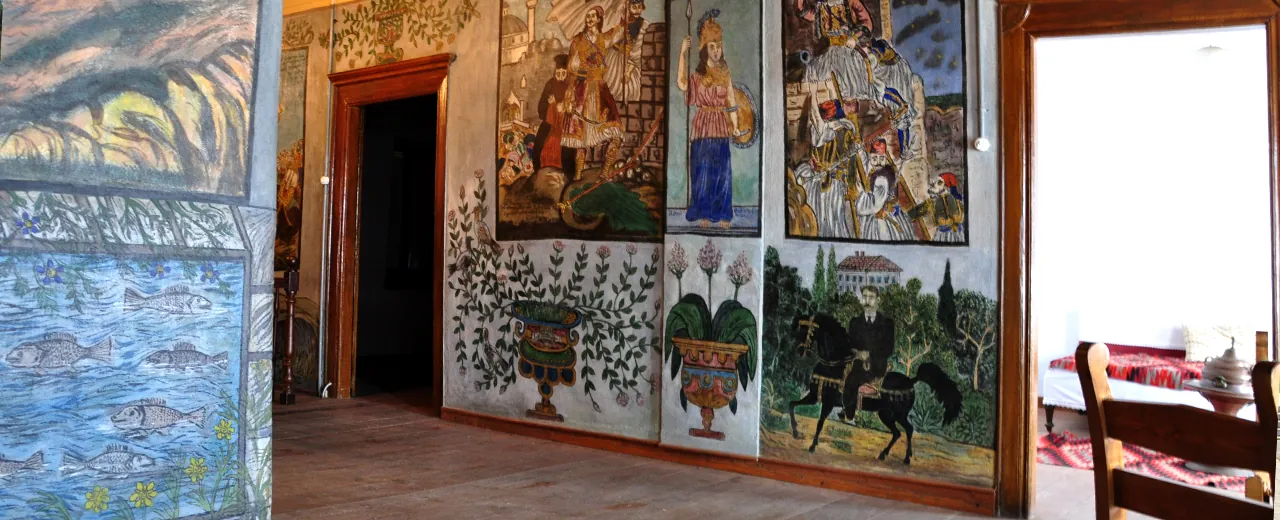
Theofilos Hatzimichail, from Mytilene, came to Pelion in the late 19th century and stayed for about thirty years. On the mountain of the Centaurs he worked with passion and inspiration and left many important works: in the Gkekas house in Agios Vlasios, the Varalis olive press, the Kontos house in Anakasia, the Kontogiannis watermill, the Velentzas bakery in Alli Meria, in cafés in Portaria and Makrinitsa and in many other places. The two most important are the Kontos house in Anakasia, known today as the Theofilos Museum, and the Velentzas Bakery in Alli Meria, both open to visitors as museums. The first keeps a complete painted decoration by Theofilos, arranged in bands, while the second has nine of his wall paintings, eight inside and one on the outside of the building. Theofilos left Pelion for good in 1927, and with him the fashion for painted house decoration in the area came to an end.
Theofilos was an unusual man. A wandering painter, he always wore a fustanella (the traditional pleated kilt) and a cape, and kept his painting tools in his belt. He lived for his art and through it tried to tell the great deeds and glories of the Greeks. His odd appearance, together with his stutter, made both the people of Volos and his relatives in Mytilene make fun of him, a sorrow that stayed with him to the end. Real recognition came mostly after his death in 1934.
Notable people and great benefactors
Besides the Teachers of the Nation Anthimos Gazis, Grigorios Konstantas and Daniel Philippidis and the painters Theofilos Hatzimichail and Ioannis Pagonis, many other important people from different fields were born or worked in Pelion.
One of them was the historian Giannis Kordatos, born in Zagora, whose research shed light on where the names of many Pelion villages come from. The doctor Dimitrios Saratsis was born in Ano Volos and did a lot for the life of Volos. Nikolaos Filaretos, from Promyri, played an important part in the uprisings of 1821 and 1854, and Kostas Garefis in those of 1854 and 1878; after Thessaly joined Greece he served two four-year terms as mayor of Milies. The writer Petros Magnis, pen name of Konstantinos Konstantinidis, was also from Zagora, where he was born and grew up.
Tsagarada was one of the luckiest villages, as it received gifts from three great benefactors: N. Nanopoulos, a Greek of the diaspora, who donated the building of the Nanopouleios School, which first worked as a commercial high school; Ioannis Kartalis, who donated the Kartaleio Primary School; and the Achillopoulos brothers, who founded the Achillopouleios Commercial School, which today houses the Digital and Miniature Museum.
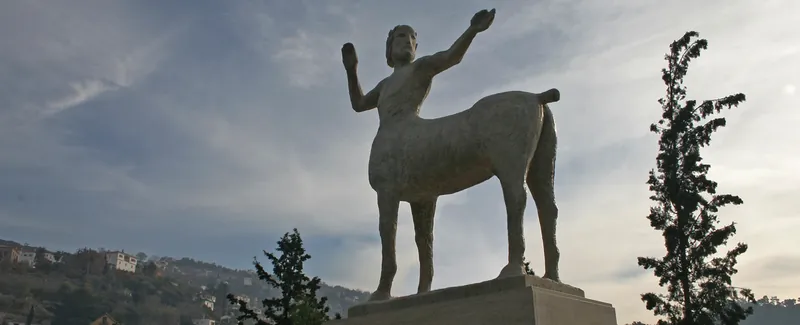
Two important artists also made their home villages known. The sculptor and engraver Nikolas (Nikolaos Pavlopoulos), from Agios Georgios Nileias, left a rich body of work and won many awards; his birthplace has the Art Museum that bears his name, with important works of his. Thanasis Fampas, a sculptor from Lafkos, donated works of his, mostly sculptures in white Pelion marble, which are now shown in the Fampeion Museum, in the village's old primary school.
Finally, we can't leave out the Italian engineer Evaristo de Chirico, father of the painter Giorgio de Chirico, who was born in Volos. Evaristo designed the Pelion railway, on which the famous little train, the Moutzouris, runs, and so contributed a great deal to the economic and social development of the mountain.
Museums
Pelion's flourishing in the arts and letters can still be seen today in its many museums. Here is a short list, so you know what you will find and where:
- Art Museum of the sculptor Nikolas, Agios Georgios Nileias: a large collection of the most representative sculptures and engravings of the Pelion artist Nikolas Pavlopoulos.
- Velentzas Bakery, Alli Meria: a stone building with nine beautiful wall paintings by Theofilos, perfectly preserved to this day.
- Theofilos Museum, Anakasia: housed in the Kontos house, it keeps a complete painted decoration by Theofilos.
- "Anetopoulos" Ceramic Pottery Museum, Lechonia: a large collection of pots and ceramics.
- Olive and Oil Museum, Ano Gatzea: well-kept objects and tools used for harvesting, processing and trading olives.
- Folklore Museum of Rural and Cultural Heritage, Drakia: over 140 exhibits on the farming life and culture of Drakia and the surrounding area, in the Triantafyllou mansion.
- Rural Economy Exhibition and Hatzigiannis Traditional Olive Press, Katichori: exhibits, objects and photos on home crafts and local farming history; at the olive press you can see how oil was made with the old, well-kept machinery.
- Fampeion Museum, Lafkos: works by the Lafkos sculptor Thanasis Fampas.
- "Antonis Tavanis" Radio Museum, Lafkos: one of the few radio museums in Greece, with a large collection of rare radios, photos and information material.
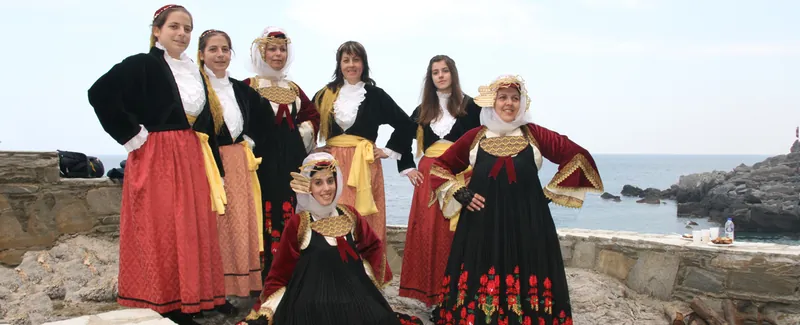
- Pelion Museum of Folk Art and History, Makrinitsa: rich folk exhibits from all over Pelion, such as household items, tools, books, jewellery and costumes.
- Milies Folk Museum: a folk collection with objects from traditional trades, needlework and icons.
- Digital and Miniature Museum, Tsagarada: folk exhibits in interactive 3D form and in miniature.
- History and Folk Art Museum, Portaria: a permanent exhibition of photos, objects, heirlooms and costumes showing how people in the area used to live.
- Nautical Museum, Trikeri: impressive maritime collections in the Koutmanis mansion.
- Angelinis Museum, Horto: a folk museum with rare items of local cultural heritage.
Pelion's small museums often have limited opening hours, especially outside summer, so it's best to check before you go.
Events
Besides the traditional panigyria (village feasts) held in every village for its saint's day or other religious holidays, with live music, dancing and sometimes theatre, many villages also organise cultural events that promote the arts and letters.
In Agios Lavrentios, every summer, the "Music Village" holds concerts and music workshops. It is one of the first international music communities in Greece, bringing artists from all over the world to the village and giving it a special character.
Lafkos has become known for its "Guitar Days", summer events with classical guitar seminars and concerts, which have welcomed internationally known guitarists and composers.
In Milies the Cultural Association organises various events every summer, while in Horto the "G. Angelinis – Pia Hatzinikou" Cultural Foundation runs two-week summer art seminars. At the open-air theatre "Aloni", just outside Agios Georgios Nileias, there are plays and concerts every year. Finally, since 2000 the Pelion Festival has been held in eastern Pelion, with arts and literature events, music seminars and theatre.
Pelion in 6 chapters
Know what you are looking at: history, nature, architecture, food, arts and customs.